Tutorial
This tutorial assumes knowledge of the Python programming language, as well as familiarity with the third party modules Numpy and Matplotlib.
A little bit of theory
The main focus is on discrete time systems of the form
where \(x_t\) is a internal state, \(u_t\) the input applied on the system, \(y_t\) the system output and \(f,h\) the state and output functions. This can be extended to include problems with noise. These discrete time systems which hence generates system data in the form
Hence, the main problem deepSI aims to address is given systems data \(D\) what is an accurate estimate of \(f,h\)?
Quick start
In this example we will fit the well known Silverbox included with deepSI. We first load the system data into our dataframe called deepSI.system_data.System_data().
import deepSI
from matplotlib import pyplot as plt
train, test = deepSI.datasets.Silverbox() # automaticly downloaded (and cashed) the system data
                                          # It also splitted the systems into two instances of System_data
plt.plot(train.y)
plt.plot(test.y)
plt.ylabel('y'); plt.xlabel('x'); plt.legend(['train','test'])
plt.show()
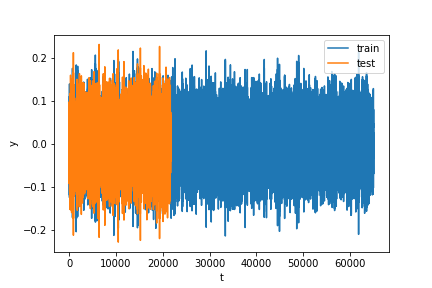
Next we can choose from countless fittable systems. For instance we can use a ARX method like deepSI.fit_systems.Sklearn_io_linear() which utilizes sklearn linear regression.
sys_SS_linear = deepSI.fit_systems.Sklearn_io_linear(na=2,nb=5)
sys_SS_linear.fit(train)
To use this system we can use deepSI.systems.System.apply_experiment() method which return a deepSI.system_data.System_data() dataframe. The measure of fitness generally used is the NRMS deepSI.system_data.System_data.NRMS().
test_simulation_SS_linear = sys_SS_linear.apply_experiment(test)
train_simulation_SS_linear = sys_SS_linear.apply_experiment(train)
print(test_simulation_SS_linear.NRMS(test)) # 0.12984812533409787
print(train_simulation_SS_linear.NRMS(train)) # 0.13541408740489072
plt.plot(test.y)
plt.plot(test.y-test_simulation_SS_linear.y)
plt.ylabel('y'); plt.xlabel('x'); plt.legend(['real test','simulation test ARX'])
plt.show()
residual plot of ARX
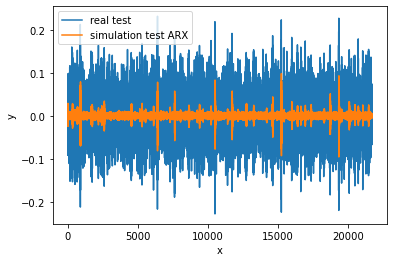
Or we can use a more advanced SI method such as the encoder method deepSI.fit_systems.SS_encoder() which utilizes the deep learning library PyTorch. Moreover it also utilizes batch optimization with the Adam optimizer. (see deepSI.fit_systems.System_torch.fit() for details)
sys_encoder = deepSI.fit_systems.SS_encoder(nx=4, na=10, nb=10)
sys_encoder.fit(train_sys_data=train, val_sys_data=test[:5000], epochs=50, batch_size=256, loss_kwargs={'nf':50})
test_simulation_encoder = sys_encoder.apply_experiment(test)
train_simulation_encoder = sys_encoder.apply_experiment(train)
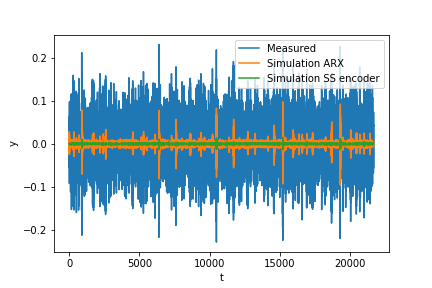
print(train_simulation_encoder.NRMS(train)) # 0.013109197256339526
print(test_simulation_encoder.NRMS(test)) # 0.01563269225510009
Which is quite a substantial improvement even without complete convergence of the optimization.
plt.plot(test.y)
plt.plot(test.y-test_simulation_SS_linear.y)
plt.plot(test.y-test_simulation_encoder.y)
plt.ylabel('y'); plt.xlabel('x'); plt.legend(['real test','simulation test ARX', 'simulation test encoder'])
plt.show()
To save the resulted encoder system we can simply call
sys_encoder.save_system('encoder-silverbox') # saves a pickle of the systems.
# sys_encoder = deepSI.load_system('encoder-silverbox') # load system
This concludes a basic use case of deepSI.
Quick tips
You can create your own system data by calling
sys_data = deepSI.System_data(u=[1,2,3,4,5],y=[1,1,2,3,5])
There is a build in quick plot method in deepSI.system_data.System_data.plot() which will automaticly set the axis labels.
sys_data.plot()
All fit_systems have as default a input and output normalization operation see deepSI.system_data.System_data_norm() and setting the sys.use_norm flag to false will disable this feature. (can be glitchy if constant values are present)
Sometimes you have multiple independent time series, one can combine these series by using deepSI.system_data.System_data_list()
sys_data_list = deepSI.system_data.System_data_list([sys_data1,sys_data2])
This can than be directly used to fit systems (SS_linear is an exception).
For hyper-parameter tuning one can use the build in functions of deepSI.fit_systems.random_search() and deepSI.fit_systems.grid_search().
Making your own systems
For this you will need to have a grasp of the basics of python classes and Inheritance. These two concepts are the basis of deepSI and makes it relatively easy to expand.
Example tutorial: https://www.w3schools.com/python/python_inheritance.asp
Afterwards take a look at the inheritance chains present (e.i. start with deepSI.fit_systems.SS_encoder() and work your way up)